China to BD Sourcing Website Development
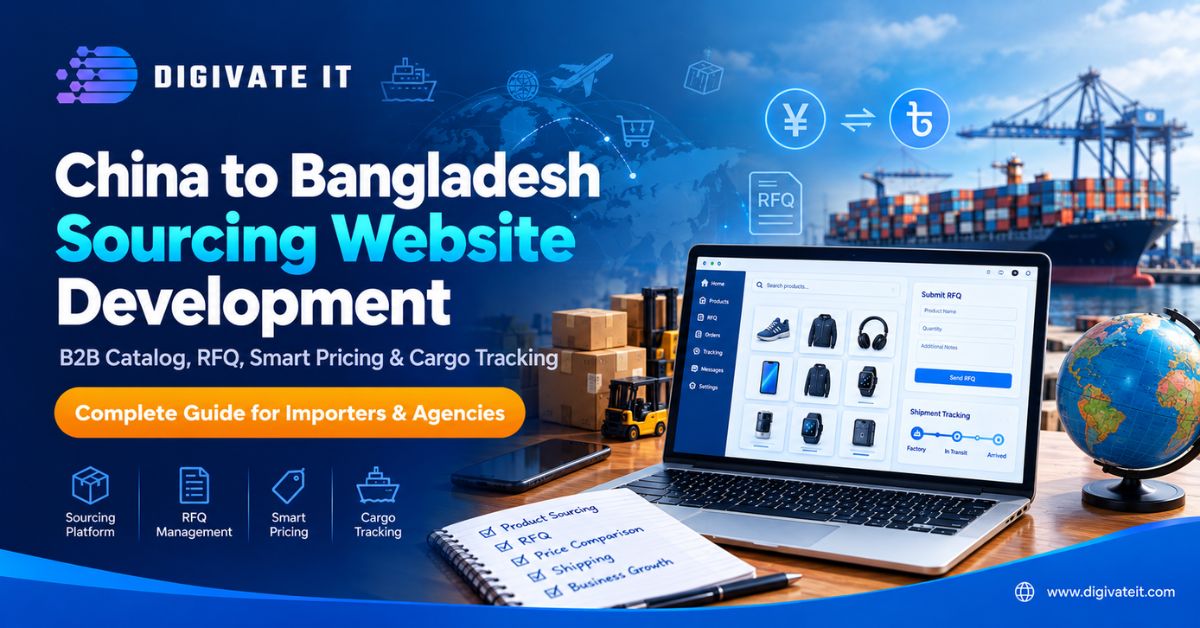
China to Bangladesh Sourcing Website Development: A Complete Guide for Importers and Agencies
How many hours do you lose each week on China sourcing?
You chat with suppliers on WeChat. You copy prices into Excel. You convert yuan by hand. You send quotes on WhatsApp.
Then a buyer asks, "Where is my order?"
A sourcing website ends this chaos. It puts catalog, quotes, pricing, orders and tracking in one place.
This guide explains how China to Bangladesh sourcing website development works. You will see the features, costs, risks and steps. We wrote it for importers, agencies and founders.
What Is a China to Bangladesh Sourcing Website?
A sourcing website connects Bangladeshi buyers with Chinese suppliers. You act as the bridge. Buyers browse products, request quotes and place orders on your site.
You handle the supplier side. You manage purchase, shipping and delivery. The platform keeps every step organized.
How It Differs From a Normal Online Store
A normal store sells items you stock. A sourcing platform sells items you source on demand.
| Factor | Normal ecommerce store | China sourcing platform |
| Stock | You hold inventory | Mostly no inventory |
| Pricing | Fixed price | Tier prices and live currency |
| Products | Limited catalog | Millions via supplier data |
| Order flow | Pick, pack, ship | Buy in China, ship, clear customs |
| Buyer type | Mostly consumers | Consumers, resellers, wholesalers |
| Special tools | Cart and checkout | RFQ, cargo tracking, margin rules |
That is why a normal theme is not enough. You need a custom workflow.
Why Build a China Import Website in Bangladesh?
Many Bangladeshi businesses already import from China. Most still run it through chat apps and spreadsheets. That works at ten orders. It breaks at a hundred.
Benefits of Your Own Platform
- Own your customers. You do not depend on a social page.
- Quote faster. Buyers see prices without waiting.
- Cut errors. Rules replace manual math.
- Build trust. Buyers can track their orders.
- Scale up. Add resellers and agents easily.
Who Should Build One?
- Sourcing agencies serving many clients
- Wholesalers who import in bulk
- Dropshippers who sell without stock
- Retail brands that want factory pricing
- Startups testing a China-to-BD niche
Choose Your Business Model First
Software follows strategy. Decide your model before you design a single page.
Model 1: Sourcing Agency Portal
Buyers send requests. Your team finds suppliers and quotes. You earn a service fee or margin.
Model 2: Product Marketplace With Imported Catalog
Products from Chinese platforms appear on your site. Buyers add items to the cart. You buy after payment.
Model 3: Dropshipping Platform
Resellers register on your site. They sell your catalog. You ship to their customers.
Model 4: Hybrid
You combine catalog, RFQ and reseller panels. This suits growing businesses.
| Model | Best for | Complexity |
| Agency portal | Service-led teams | Low |
| Catalog marketplace | Retail and wholesale | Medium |
| Dropshipping | Reseller networks | Medium |
| Hybrid | Scaling brands | High |
Our advice: Start with one model. Prove it works. Add layers later.
Must-Have Features of a B2B Product Sourcing Platform
A good B2B product sourcing platform does more than list products. Here are the features that matter.
1. Product Catalog and Import Tools
Buyers need rich product pages. They want images, variants and clear specs.
- One-click import from supplier platforms
- Auto translation from Chinese to English or Bangla
- Variant mapping for color, size and model
- Duplicate detection
We covered the data side in depth in our guide to 1688 API integration service in Bangladesh.
2. Image Search and Smart Discovery
Many buyers do not know the right Chinese keyword. They have a photo instead.
Reverse image search solves this. The buyer uploads a photo. The system finds matching factory products.
3. Dynamic Pricing Engine
Pricing is where margin leaks happen. Automate it.
- Live CNY to BDT conversion
- Global and per-product margins
- Tier pricing by quantity
- Freight cost by KG or CBM
- Customs and tax buffers
4. RFQ (Request for Quotation) System
Some buyers want custom items. An RFQ lets them describe what they need. Your team replies with a quote.
Good RFQ tools include:
- File and photo upload
- Quantity and target price fields
- Status tracking
- Quote history
5. Order and Payment Management
Keep orders clean. Show clear statuses.
- Order stages from payment to delivery
- Partial payment or advance options
- Invoices and receipts
- Local payment gateway support
Check current rules on foreign payments with Bangladesh Bank.
6. Cargo and Shipment Tracking
Buyers always ask, "Where is my parcel?" Answer before they ask.
- Status from China warehouse to Dhaka
- Air and sea freight options
- Tracking numbers and timeline view
- Email and SMS alerts
7. Reseller and Affiliate Panels
Resellers grow your reach. Give them tools.
- Reseller registration and approval
- Bulk order forms
- Commission tracking
- Wallet or payout reports
8. Admin Dashboard
Your team needs control. A strong dashboard includes:
- Role-based access
- Sales and margin reports
- Supplier notes
- Notification templates
9. Built-In SEO
Sourcing sites can have thousands of pages. Manual SEO is impossible. Automate it.
- Auto meta titles and descriptions
- Clean URLs
- Structured data for products
- XML sitemaps
Learn how product markup works in Google's structured data documentation.
Feature Priority Table
Not everything must launch on day one. Use this guide.
| Feature | Launch phase | Why |
| Product catalog and import | Phase 1 | Core value |
| Pricing engine | Phase 1 | Protects margin |
| Checkout and orders | Phase 1 | Revenue |
| RFQ system | Phase 1 or 2 | Custom demand |
| Image search | Phase 2 | Better discovery |
| Shipment tracking | Phase 2 | Trust and support |
| Reseller panel | Phase 2 or 3 | Growth channel |
| Affiliate tracking | Phase 3 | Referral growth |
Build Custom or Buy a Script?
Many people search for a China product wholesale platform script in BD. A script is a ready-made code package. It is cheaper at the start. It also has limits.
Ready-Made Script
Pros:
- Lower upfront cost
- Faster launch
- Good for testing an idea
Cons:
- Limited custom workflows
- Shared code and design
- Hard to scale
- Security depends on the vendor
Custom Development
Pros:
- Built around your process
- Unique design and brand
- Full code ownership (confirm in contract)
- Easier integration with suppliers and couriers
Cons:
- Higher upfront cost
- Longer timeline
Quick Comparison
| Factor | Script | Custom build |
| Cost at start | Lower | Higher |
| Launch speed | Fast | Medium |
| Flexibility | Low | High |
| Brand uniqueness | Low | High |
| Long-term scaling | Limited | Strong |
A smart path: Use a script to test demand. Move to custom once orders grow. Or start custom if your process is unique.
How to Build a China Import Website in Bangladesh: Step by Step
Here is the process we follow at Digivate IT.
Step 1: Discovery and Goals
We ask simple questions first.
- Who are your buyers?
- Which products will you sell?
- How do you source today?
- What slows you down?
Step 2: Choose Your Data Source
Decide how products will enter your platform. Options include official platform APIs, authorized data vendors, or manual catalogs. Each has trade-offs.
For China wholesale data, see our detailed breakdown of official vs third-party access.
Step 3: Plan the Workflow
Map every step from search to delivery. Include who does what. Include what happens when something fails.
Step 4: Design the User Experience
Good design builds trust. Focus on:
- Clear search and filters
- Mobile-first layouts
- Fast product pages
- Simple checkout
Most Bangladeshi buyers browse on phones. Test on small screens first. Follow Google's Core Web Vitals guidance for speed.
Step 5: Develop the Core Platform
Our developers build the backend, admin panel and storefront. We connect the pricing engine and data import.
Step 6: Integrate APIs and Third Parties
Typical integrations include:
- Supplier product data
- Payment gateways
- Courier and logistics partners
- SMS and email services
- Translation services
Step 7: Test Everything
We test with real scenarios.
- Import 50 products
- Place a test order
- Submit an RFQ
- Check price math
- Try failed payments
Step 8: Launch and Train
We launch in stages. We train your team on the admin panel. We share simple guides.
Step 9: Maintain and Improve
Platforms need care. APIs change. Exchange rates move. We monitor, fix and improve over time.
Typical Development Timeline
| Phase | What happens | Estimated time |
| Discovery | Goals, workflow, scope | [1 week] |
| Design | Wireframes and UI | [1–2 weeks] |
| Development | Core platform and admin | [4–8 weeks] |
| Integrations | APIs, payments, logistics | [2–4 weeks] |
| Testing | QA and fixes | [1–2 weeks] |
| Launch | Go-live and training | [1 week] |
What Does Cross-Border B2B Ecommerce Website Development Cost?
Cost depends on scope. We price website design and API integration separately. This keeps quotes fair.
| Cost item | What is included |
| Website design and development | Storefront, user accounts, checkout, admin panel |
| Data and API integration | Product import, image search, pricing sync |
| Advanced modules | RFQ, reseller panel, affiliate tracking, cargo tracking |
| Hosting and security | Server, SSL, backups |
| Ongoing support | Monitoring, updates, fixes |
What Changes the Price?
- Number of features
- Custom design depth
- Data source type
- Languages and currencies
- Integrations needed
- Team training needs
Tip: Ask for a written scope. Vague quotes cause surprise bills later.
Legal and Compliance Basics for Bangladeshi Importers
A website does not replace import rules. Check these before you launch.
- Import registration and licenses: See the National Board of Revenue (NBR).
- Customs duty and tax: Confirm current rates by product.
- Product standards: Some items need approvals. See BSTI.
- Foreign payments: Follow Bangladesh Bank guidance.
- Banned or restricted goods: Block them in your catalog.
Rules change often. Confirm with an expert before launch. This article is not legal advice.
Security and Performance Best Practices
Trust is your biggest asset. Protect it.
- Use HTTPS on every page
- Hide API keys on the server
- Limit admin roles
- Back up daily
- Log important actions
- Cache product pages for speed
- Monitor uptime
For deeper guidance, see the OWASP Top 10.
Common Mistakes to Avoid
We see these errors often.
Mistake 1: Skipping the Business Plan
Developers build what you ask for. If the plan is unclear, the site will be too.
Mistake 2: Ignoring Landed Cost
The supplier price is not your cost. Add freight, duty, VAT and payment fees. Then set your price.
Mistake 3: Too Many Features at Launch
Big launches delay revenue. Start with core features. Add more with real feedback.
Mistake 4: Poor Mobile Experience
Slow or cluttered pages lose buyers. Test on mid-range phones.
Mistake 5: No Support Plan
APIs and rates change. Plan for monitoring from day one.
Mistake 6: Weak SEO Setup
A sourcing site can have thousands of pages. Without clean structure, Google may not index them well.
SEO Tips for Your Sourcing Website
Good SEO brings buyers without ad spend. Focus on helpful content.
- Write useful category pages. Explain who each category serves.
- Add buying guides. Help buyers choose products.
- Use original product descriptions where possible.
- Add structured data for products and FAQs.
- Build local trust signals. Show address, contact and reviews.
- Keep pages fast.
Google's guidance on helpful, people-first content is a good checklist.
Why Choose Digivate IT as Your Wholesale Sourcing Website Design Agency?
Choosing a wholesale sourcing website design agency is a trust decision. Here is what we offer.
- Sourcing-focused builds. We understand RFQ, margins and cargo flows.
- Ready modules. Image search, one-click import, reseller and affiliate panels, and shipment tracking. See our 1688 sourcing platform demo.
- Separate, clear pricing. Design and API costs are quoted apart.
- Local understanding. BDT, local payments and Bangladeshi buyer habits.
- Ongoing care. Monitoring, updates and support.
Explore more: ecommerce website development, custom software development , and contact us .
How to Choose a B2B Product Sourcing Platform Developer in BD
Ask every agency these questions.
- Have you built a sourcing or import platform before?
- Can I see a live demo?
- Who owns the source code?
- How do you handle pricing and currency logic?
- Which APIs and couriers can you integrate?
- What support do you offer after launch?
- How do you protect my data?
Vague answers are a red flag.
Is Your Business Ready? Quick Self-Check
Tick what applies:
- You manage orders in chat apps or Excel
- You quote prices by hand
- Buyers ask for tracking often
- You want resellers or agents
- You plan to grow in the next year
Three or more ticks? A custom platform likely pays off.
Final Takeaways
- Pick your model first. Strategy comes before software.
- Launch core features. Catalog, pricing, orders and RFQ.
- Add layers later. Image search, tracking and reseller tools.
- Count landed cost. Price for profit, not guesswork.
- Check compliance. Import rules still apply.
- Plan maintenance. Platforms need steady care.
Ready to Build Your China Sourcing Platform?
Stop managing imports through chat apps. Give your buyers a professional experience.
Digivate IT can scope your project, choose the right model and build a platform that grows with you.
👉 Book a free consultation with Digivate IT
Frequently Asked Questions (FAQ)
Find clear, expert answers to the most common questions regarding this article below.
A basic platform can take a couple of months. Complex builds with RFQ, image search and reseller tools take longer. Scope and approvals drive the timeline.
You usually need valid trade and import registration. Rules vary by product and business type. Check with the NBR and a qualified advisor.
Yes. The system can read prices in yuan. It then converts to BDT using current rates, then adds your margin and freight.
Yes, with image search features. The buyer uploads a photo. The system finds similar supplier products.
It can work for testing. Scripts often limit custom workflows. Growing businesses usually move to custom builds.
Yes. You can add reseller registration, bulk orders and commission tracking. You then ship orders to the reseller's customers.
The platform stores status updates from your logistics partners. Buyers see a timeline from the China warehouse to delivery.
It can be. Clean URLs, meta tags and structured data help. Helpful content and fast pages matter just as much.
This depends on your contract. Always confirm code ownership and handover terms in writing.
Yes. Many clients launch with core features first. They add image search, tracking and reseller panels as orders grow.
Need Help with Software or Automation?
Talk to our technical experts today on WhatsApp for instant guidance.