
WhatsApp Marketing vs Telegram Marketing: Which Works Better for Your Business?
The Question Every Marketer Asks
If you’ve ever tried digital marketing in Bangladesh—or anywhere, really—you’ve probably faced this dilemma:
Should I push harder on WhatsApp marketing, or start building a Telegram community?
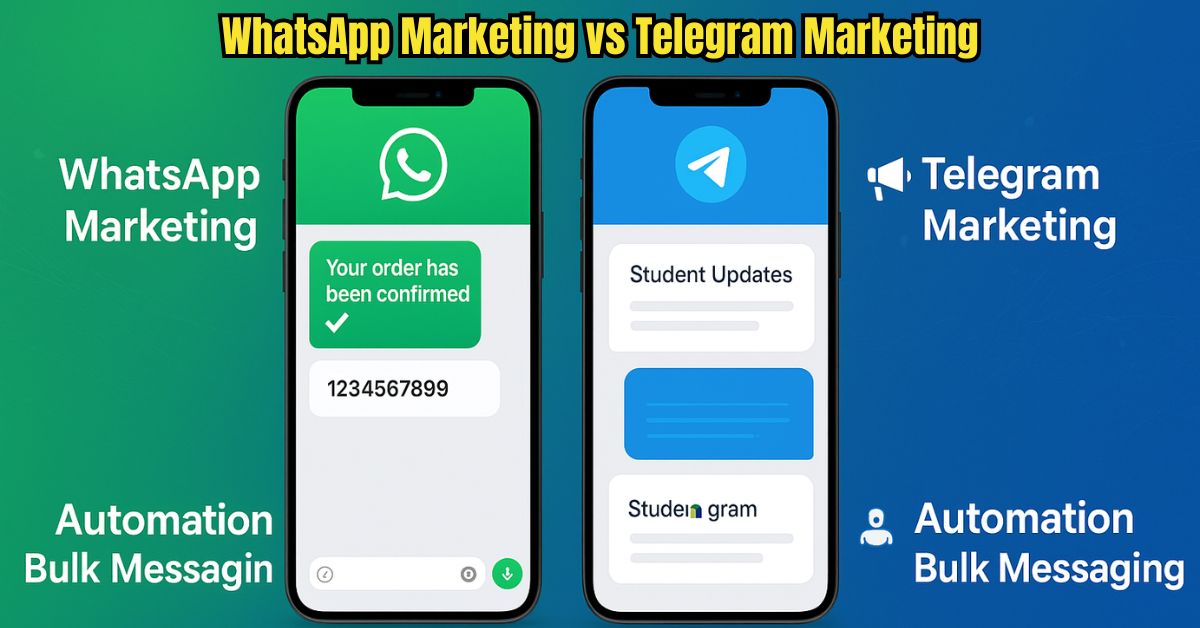
On the surface, both apps look similar. They’re both messaging platforms. Both allow you to send updates, build groups, and connect with people in real time. But once you dive deeper, they behave very differently—and those differences can make or break your campaign.
I’ve worked with businesses that swore by WhatsApp, and others that found Telegram to be a lifesaver. Let’s break this down honestly, with examples, not just buzzwords.
WhatsApp Marketing: The Familiar Giant
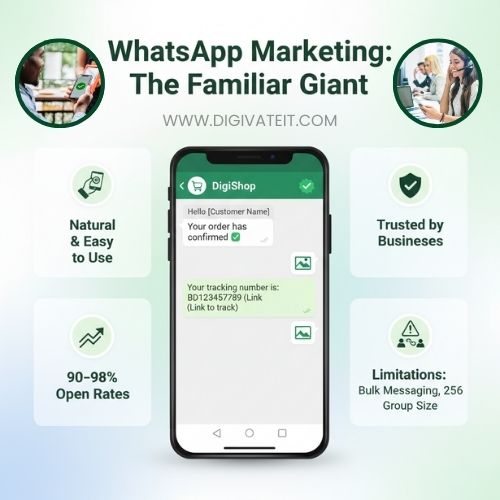
Most people reading this probably already use WhatsApp every single day. In Bangladesh, it’s often the default way to confirm an order, share a tracking number, or answer a customer question.
Why Businesses Love WhatsApp
-
It feels natural. People don’t need an introduction to WhatsApp—it’s already on their phone.
-
High open rates. If you send a WhatsApp message, chances are it gets read. In fact, open rates often reach 90–98%, which is unheard of in email marketing.
-
Trust factor. Because it’s owned by Meta, people recognize the green tick on a business account and instantly feel safer.
The Downsides
But WhatsApp isn’t perfect. If you try sending bulk messages without using the official Business API, you’ll quickly hit restrictions. Spam control is strict, and accounts get banned if abused.
Also, WhatsApp groups are small (only 256 members). For a brand looking to build a massive audience, that can be limiting.
Example: One of our local e-commerce clients relies heavily on WhatsApp to confirm COD (Cash on Delivery) orders. It works brilliantly for fast, one-to-one communication, but when they tried to run “broadcast” campaigns, scaling became painful.
Telegram Marketing: The Underdog With Big Muscles
Now, Telegram is a different story. If WhatsApp is your cozy family living room, Telegram is more like a stadium where you can gather thousands of people at once.
Why Some Marketers Prefer Telegram
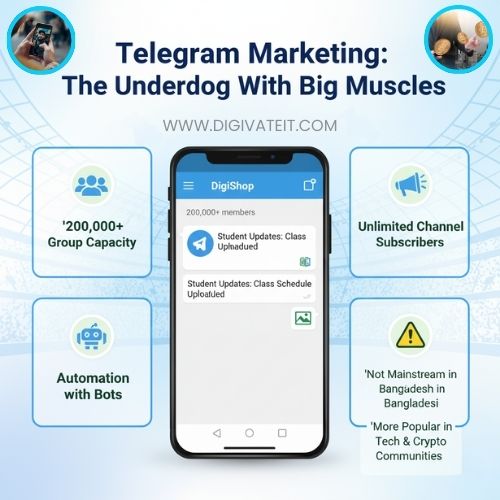
Huge group capacity. You can host up to 200,000 members in one group.
Unlimited channel subscribers. Perfect for broadcasting without worrying about caps.
Automation. Telegram bots can do everything from handling FAQs to selling products automatically.
Fewer restrictions. Unlike WhatsApp, you’re not constantly worried about being flagged as spam.
The Weak Spots
But Telegram has its hurdles too. Many everyday users in Bangladesh still don’t have it installed. It’s popular among tech-savvy crowds—crypto traders, online learning groups, and digital communities—but your average local shopper? They may not even check it daily.
Example: A coaching institute we worked with runs all their student updates through Telegram. It’s efficient because thousands of learners can be in one channel. But when the same brand tried Telegram for local admission campaigns, results were weaker compared to WhatsApp ads.
Quick Comparison: WhatsApp vs Telegram for Marketing
| Feature | Telegram | |
|---|---|---|
| User Base | 2.7B+ (mainstream) | 1B+ (tech-driven, global) |
| Group Size | 256 limit | 200,000+ |
| Broadcasting | Restricted | Unlimited |
| Automation | Limited (via API) | Advanced (bots) |
| Best For | Customer service, local businesses, sales confirmations | Communities, education, crypto, content broadcasting |
So, Which One Should You Choose?
Here’s the honest truth: there’s no single winner.
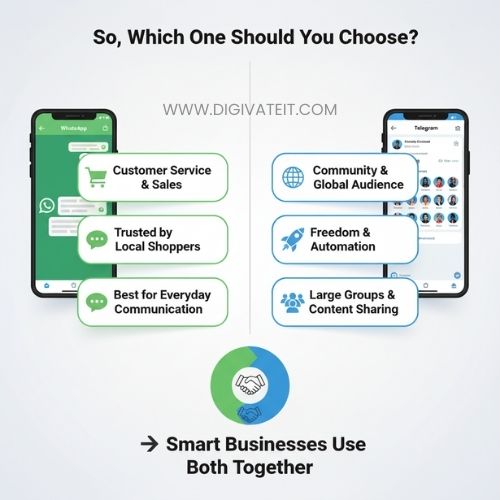
If your customers are local, everyday shoppers, WhatsApp is unbeatable. It’s where they already are, and it builds trust.
If you’re building a community or global audience, Telegram offers freedom, scale, and automation.
Smart businesses don’t treat it as WhatsApp versus Telegram. They use both together.
WhatsApp for customer service and sales.
Telegram for content sharing and long-term community building.
Future Outlook in 2025

-
WhatsApp is moving towards payments, AI-driven chatbots, and deeper integration with Meta Ads. Imagine completing an entire purchase inside WhatsApp.
-
Telegram is focusing on creator tools, monetization, and advanced bots. It may never beat WhatsApp’s numbers, but it will always have a loyal niche audience.
Conclusion
If you came here asking “Which is better: WhatsApp or Telegram marketing?”, the answer depends on your audience:
WhatsApp = Trust, mass adoption, customer service.
Telegram = Scale, automation, niche communities.
At Digivate IT, we help businesses set up both WhatsApp and Telegram campaigns—so you don’t have to choose one over the other.
Want to see which platform works best for your business? Let’s talk
Digivate IT's WhatsApp and Telegram Marketing Software
TGTools

TexApi
TexSender

WhatsApp CRM

WASender

WSTOOL

BotMaster
FAQs: WhatsApp vs Telegram Marketing
1. Which platform has better engagement?
WhatsApp usually wins on engagement rates, but Telegram wins on community interaction.
2. Can I send bulk messages on WhatsApp?
Yes, but only through the official WhatsApp Business API to avoid bans.
3. Is Telegram popular in Bangladesh?
Not as much as WhatsApp, but it’s growing in tech and student circles.
4. Why do crypto businesses use Telegram?
Because Telegram supports huge groups, bots, and unfiltered discussions.
5. Should I focus on one platform or both?
If budget allows, use both—WhatsApp for conversions, Telegram for community building.
WhatsApp usually wins on engagement rates, but Telegram wins on community interaction.
Yes, but only through the official WhatsApp Business API to avoid bans.
Not as much as WhatsApp, but it’s growing in tech and student circles.
Because Telegram supports huge groups, bots, and unfiltered discussions.
If budget allows, use both—WhatsApp for conversions, Telegram for community building.
Need Help with Software or Automation?
Talk to our technical experts today on WhatsApp for instant guidance.